Wednesday, August 1, 2012

Food for thought

I packed a lunch the first time I went on a Street Retreat with the Faithful Fools. While I considered myself comfortable in the Tenderloin, I knew I wasn't going to eat at one of the soup kitchens. I don't remember anymore the precise reasons I gave myself not to, but when I hear others give them, they sound familiar: the food will be bad, I don't want to eat food someone who really needs it might, they won't have anything that meets my dietary requirements, I don't want to waste time standing in line I could use doing something more useful or interesting. 
 
Of course, there's always fear: the dining halls that serve hungry people for free are almost always out of view – in basements or behind windowless walls or fences. Until we go into one, we don't really know what happens there, who eats there, or what they eat. When we go in as a volunteer, we get to see some of this, but our name sticker or apron and permission to stand behind the counter – our identity as a server rather than guest or client – shows us a different side of the experience.

In the twelve years since that first Retreat, I have partaken in free food offered by dozens of organizations in San Francisco and around the U.S., and I find myself reflecting on these experiences now that the Fools and I have committed to support Welcome in its work to provide food and hospitality to people every Tuesday and two Saturdays per month. The experience I've had at each meal is as varied as the people who serve it.
One of my favorite places to eat for free lies behind a tall, nondescript fence on a busy street. If you arrive early, you are handed a number and can sit on a rock in the garden as you wait for your group to be called. There's always a vegetarian soup and a fresh salad, and when there's another soup with meat, or croutons for the salad, the volunteers will ask if you want some before serving you. A little out of the way, and serving a somewhat specialized fare, the few hundred who eat there each day are treated to a comparatively quiet space where the chairs never seem to all fill, encouraging lingering.
Programs that feed thousands a day don't have those same luxuries – when a line wraps around a city block, it doesn't make sense to have guests just sit and chat. Larger programs also tend to find efficiencies in serving the food as well. Trays are usually uniformly filled assembly-line style and passed with a smile to guests who then go looking for a seat. One morning at a large feeding program, I was dismayed to discover my bagel was slightly moldy. I felt worse upon looking around the table and seeing that mine was the least moldy bagel at the table. I was struck that each tray was passed through the hands of three volunteers after being filled, before reaching the guest's hands. Was there a moment when any volunteer asked “will the person who gets this tray want to eat it?”
Hungry people get fed when someone realizes there is a need, and finds a way to meet it. This means feeding people in the space available, which can be a church basement entered via long passages and stairways revealing the pipes and inner-workings of the building, a space built for the purpose of feeding people, or sometimes outside in a park, square, or sidewalk. After finding a closed door at an address I found on a free food list in New York City, I waited on the steps outside a train station until a van drove up and handed out baloney sandwiches, punch, and an apple to those of us gathered. 
 
One of my favorite food programs says “This is not charity. This is a protest!” and feeds hundreds in view of City Hall with discards collected from stores and restaurants – at its best we get organic soup and salad, at worst it's been a bucket of oatmeal that arrives (still welcome by hungry stomachs) an hour late.
One time, while standing in line for another meal, I saw a man dancing in a flowing straw mask to a couple of drummers while others walked away from this surprising ritual with plates heaped with colorful fragrant fare. Over the years, this unique group has grown, both in guests and volunteers, but the founder continues his practice of walking down the line, and taking each person's hand as he looks them in the eye and says “Happy Tuesday!” His spiritual practice extends to fasting each Tuesday until all guests are fed, and the love he expresses in the songs of gratitude he sings throughout the meal is a nourishing of the soul as the food he shares from his homeland is of the body.
We all have eaten food from someone else's kitchen – maybe a friend's, a family member's, a restaurant's, or a soup kitchen's - and from that know the difference between a great meal and something that just filled our stomach. When you are hungry, a full stomach can be a great thing, but the exchange of care and love provides a lasting nourishment those who come to eat as well as those who offer the meal.
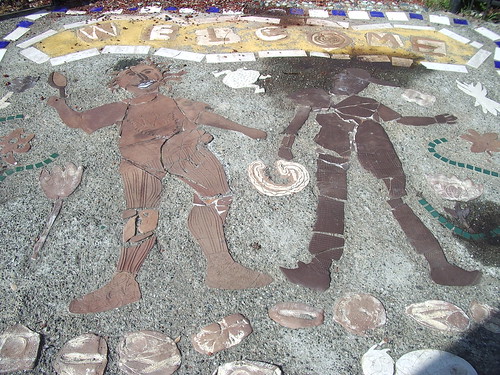
As we serve our meals at Welcome, we reflect on the ingredients that make up a great meal: What can we serve that is healthy? That tastes good? How does our preparation show the care we feel for our guests? How do we stay centered in our role as hosts? How do we encourage politeness and comfort among both guests and hosts? How do we help everyone feel Welcome?

Join us for a meal sometime! Tuesdays 2-4pm. 2nd and 4th Saturdays 5:30-7pm.

Friday, March 9, 2012

"Guide My Walking..."


This post was written for the Faithful Fools' March Newsletter, found here.
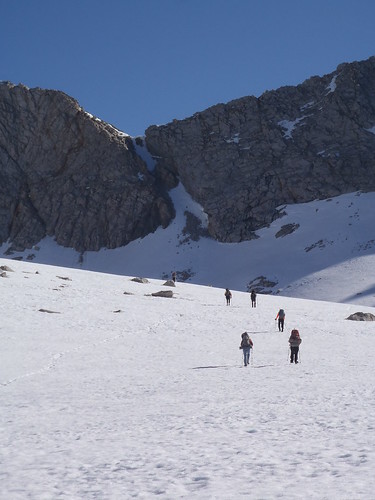
PCT hiker on the Big Horn Plateau


“Be thou my feet, and guide my walking
Be thou my eyes, that I may see
Open my heart, give me compassion
Hear my cry, and answer me...”

This song by Juliana Howard became my mantra as I walked with myself. It had been a few days since I had last seen another hiker and, with the trail covered under several feet of snow, the comforting sense that I was traveling the same route as anyone else came and went with footprints I would stumble upon from time to time. I had only a few days of food with me, and I started to wonder if I would make it out of this section of wilderness at all, let alone in time to meet the friends that would be waiting for me at the next road-crossing. I had spoken with the National Park Ranger for this area just before starting north of Tuolumne Meadows. She said she was looking forward seeing her territory for the first time in about a week, but would have to wait out the snow before starting to patrol it regularly. This was more solitude than I had bargained for.

The mantra helped. It lifted my spirits some: in part because of the fond memories of learning and singing it for the first time with a cadre of Fools on a Seven Day Street Retreat, in part because it helped remind me that, as small as I am, the greatness that surrounds me is something I am connected to, something I am a part of. I no longer had to rely only on my own eyes to see where I was going, on my own feet to find the way. The way and I could find each other. We did find each other, over and over, and with a timing that challenges my scientifically-trained skeptical mind: it seemed that the footprints I came to rely on to double my speed of travel (the map I had of this section was woefully inadequate for navigation in snow) would appear to me at the moments when I was deepest in the mantra, and least focused on my own fear and misery. 

Whatever journey I'm on, walking the streets, in the wilderness, or on the path of my daily life, I strive to recognize myself in the place I'm in. When I'm distracted by myself – thinking about what I've done, what I think I'm going to do, or how I'm feeling – I often miss what's around me, sometimes to the extent of missing my path itself. Similarly, when I'm looking only outward at the world, I can forget that I am a part of it. When I sing “Open my heart, give me compassion; Hear my cry, and answer me,” I am called to extend compassion to myself and the world together, for we are the givers and those who need compassion simultaneously. The world and I cry together, and together we can answer that cry.
Approaching Forester Pass

My fourth day in this desolate area began at dawn with a ice-cold hour of crossing the snow-fed braids of Piute Creek. It continued with several hours of climbing up and down the ridges separating drainages that feed Hetch Hetchy, the reservoir supplying water to San Francisco. At 4pm, I stood shivering in a patch of sunlight, having just swam across the 30-foot wide Stubblefield Creek, which was still over my head at its opposite shore. The deer I saw on the other side gave me a look I read as “what are YOU doing here?” I hiked on, needing to make time in order to meet my friends the next day. I found footprints again when I most needed them – in a featureless area: flat, away from creeks or lakes, and deep in trees blocking possible views of surrounding peaks – and followed them to the edge of Wilma Lake. I followed the prints as they picked a path through the trees, staying just above the icy lake shore. As I came around to the inlet, which more merged with than entered the lake, I saw my path-finders standing on a bridge ankle-deep in water. We made camp shortly after, and hiked together the next day until we hit trail good enough that I could go on ahead and meet my friends, just as they had sat down to dinner.

It is a cliché that we go on journeys to find ourselves. When we surround ourselves in a new context, we get a new perspective. These perspectives slowly give us a fuller picture of who we are, and we begin to piece together our core being from the parts of us present in every context. 

Hiking alone in the high Sierra
A journey also is a time to remember who we have with us. At the beginning of each Street Retreat, we toss a ball of purple yarn around the circle, connecting us to each other, as well as to the thousands of previous and future Retreatants who participate in the same ritual. I don't have a ball of yarn in hand at the beginning of every journey I take, but the Faithful Fools – and what I have learned with them – are always with me.

Sunday, February 26, 2012

Glass Houses


Sitting, of all places, on the toilet when it happened, I heard two successive loud bangs on the roof, followed by a third which was accompanied by the crash of something breaking. Finished with my business, I quickly got up to investigate, but first had to take a few minutes to fill a bucket and flush – I figured there was really nothing I could do immediately to stop whatever was happening.

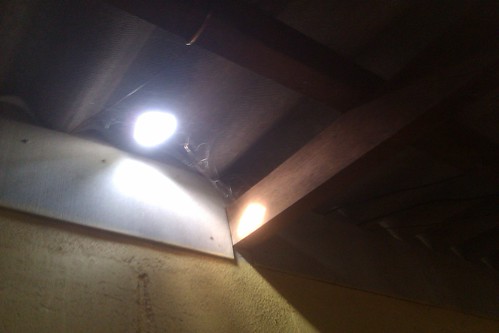
The free skylight!
When I realized there was a hole in the roof I helped replace last year, I briefly cursed the ceramic-like material we chose instead of the more commonly used zinc. Then I remembered that it is the insulating properties of the material that allow meetings, like the free electricians' class that was suddenly scrambling to understand the noises, to happen on hot afternoons like this one in the Barrio. Several students ran up the alley to the field behind the house to investigate, a couple more went into the back garden to see if they could spot the culprits, while I surveyed the damage – wondering what, really, could be done if we did find the responsible parties. This is a neighborhood where who the ladrones are is talked about openly, and the police sometimes have to be fetched in a taxi to investigate a burglary.

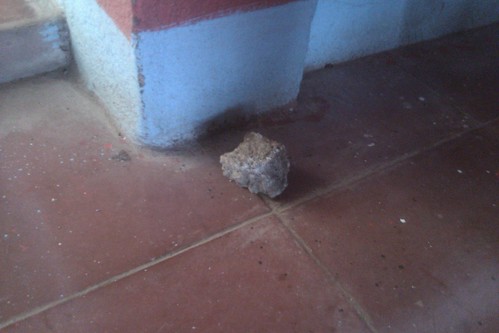
I found the fist-sized hole above the cabinet where we keep the games and childrens' books, just outside the kitchen door. A few feet away was the small chunk of concrete that had been hurled – I imagine with some sort of sling – with enough force to shatter the roof panel. Three other small holes revealed the contact points of less-destructive throws.
The rock: really a tangerine-sized chunk of concrete.
I find myself trying to process my emotions while the six students who aren't looking for the stone throwers, and their teacher from the Technical School - who says “that woke us up!” - mill about anxiously. Do I feel unsafe? Barely – I feel a bit more vulnerable than usual, for sure, but for some unexplained reason I feel ready to deal with whatever might happen to me, even if it were a rock to the head. What about the children, and the other adults who use this place, mostly when I'm not here? Yes, I definitely feel concern for them, and for Marria, who I have invited to join me on this visit. This needs to be a place where people feel (and are) safe, where they can relax – a retreat from the busyness and anxiety that are so often byproducts of the struggle for survival in the modern world.

What would I do if I had the chance to confront the rock-throwers? Yell at them? (What, really, would that accomplish?) Call the Police, and try to make sure they get punished? I struggle to find a punishing bone in my body. Life is so full of natural consequences, why would I need (or want) to increase the pain in this world that so often feels over-full of it? The closest I feel to resolution in those fifteen minutes after the incident is that I want to invite the stoners over to the house, to explain what it is for, and to find out what it is they need. Maybe that would shed some light on what inspired them to hail rocks on our roof. (Was it only our roof? I heard no reports of other roofs being hit.)

A beam of sunlight serves as a constant reminder as the adrenaline wears off, and I continue reflecting on the event, what might have caused it, if there's something I should do about it. Somehow it is easier for me to consider the house a target, rather than be a subject of totally random violence. Maybe it's like a sugary sweetener feeding my gringo guilt. Of course we should be the target: we have a brand new roof, and a water tank, and a new paint job, and most of the year no one even lives in this house! To some, this house could represent the wealth and hegemonic power of the United States, more or less dependent on exploitation of countries like Nicaragua and its people; the U.S. role in overturning the Nicaraguan revolution, facilitated by drug and arms sales; the hundreds of years of colonial history, which left the largest, most resource-rich country in Central America its poorest, with still-beautiful landscapes growing out of clear-cut jungle. Of course I am just making up someone else's story, using what I know, and looking from my own perspective. I don't know why this happened any more than I do who did it.

When I take the time, though, to think about myself, I remember that my own behavior often reflects the care I feel I am receiving from others. How many times have my arguments and fights with my siblings been born out of jealousy for what they got from my parents? When have I taken liberties with employers: when I believe they really cared for my well being as much as their own, or when it seemed like they were out for only their own good? Have I ever left a MacDonalds cleaner than I found it? How about the home of a gracious host? I want to care for these piedrinos in the way I feel cared for, in the way I feel care for them. For though I don't know them, I do care for them, and about them; and, as members of this community, in some unknown way I feel they are caring for me, though throwing rocks isn't their most precise way of doing so.

It comes to me simply and directly, as a cat who's ready to be pet now: I will confront what feels like uncarefulness with care. I decide to go into the street in front of the house and clean up the garbage, carelessly tossed there like the rocks on my roof.

In the spirit of the Faithful Fools, who believe wehave what we need before it is asked of us, I find an extra garbage sack in front of the house (we reuse them here). If that weren't enough, when the neighborhood kids ask me what we'll do together tomorrow, I tell them what I really want to do is clean the street; and they ask what time, and debate over when it won't be too hot, and then show up promptly at 4pm and we clean for an hour. In the end, I don't know if what I've done will keep more rocks from falling on the roof of the Casa Misionera Franciscana, or keep the culprits from doing it to someone else, but I feel like I helped some kids who could grow up to be rock-throwers find something to do when they're bored that probably feels better than throwing rocks at someone's house.

I can't help but think that maybe we all live in glass houses, and the first stone isn't the only one we shouldn't throw.

Paz y amor.

Friday, November 18, 2011

Occupy your life!

There are protest signs hanging and leaning all over the Occupy San Francisco camp. The most striking is a huge banner hanging from a line strung between two lamp-posts that claims: “This is a living example of a better system.” This ambitious and hopeful message appeals to the Utopian in me. Despite my hopes, Occupy SF is not Utopia. On the other hand, it is naive to expect it to be a perfect society.

The people at the Occupy camp are there to call attention to our collective short-comings. The most obvious of these, and the reason we are occupying Wall Street and San Francisco’s financial district, is the obscene expansion of wealth and political power in the hands of the richest 1% over the past 30 years. Among the revolutionary elements of the Occupy Movement is its General Assembly which features distributed leadership, whereby all members of the community are intended to have equal say, a consensus process which forms community by making group decisions without winners and losers, and the “People’s Mic” which encourages the community to listen closely and repeat each other’s words. These are the hallmarks of an attempt to change the way we relate to power and to those we live and struggle alongside. At the General Assembly I attended at Occupy SF, all people were given equal access to the floor - no one was marginalized for being angry, or inarticulate, or for believing we are all preparing to fly off in a galactic spaceship of love. Where else do we find governance this inclusive?

The occupiers come to the movement with symptoms of our society's untreated illnesses: poverty, hunger, addiction, greed, impatience, authoritarianism, and physical and mental illness. In the few hours I have spent at Occupy SF, I have seen examples of some of the behaviors I like least to see in my community: people arguing, fighting over resources, accusing each other of wrong-doing, making violent threats, and using methods to police each other’s behavior that too closely mimic the authoritarian structures we are talking about changing. I have grown accustomed to this type of behavior in my everyday life, but experiencing it among the people I see holding the hope to change society can be disheartening.

But the banner rings true - “this is a living example of a better system.” Despite the frustrations, and our own and each other’s weaknesses, the Occupiers say, “I am working with you to make a better world and I will work to improve myself, and support you in your growth, as we figure out what this means.” This can be hard and lengthy work. I am grateful no one has defined a goal or finish line for the movement, because to make a change merely to the political or economic structure would leave this deeper work undone. When we change the way we relate to each other, wealth, and power, those structures will adapt to our new relationships. If the changes are only new laws and new leaders, the old relationships will find a way to recreate the themselves in the new environment. True revolution is a change within the people who make up society, not a shift in the hands who hold the tools of oppression.

What this calls upon all of us to do is to go out into the streets and begin to make the society we long to see.  Anyone who is in the bottom 99% income bracket, or sympathetic to their needs, has a right (perhaps a responsibility?) to guide a movement who claims to speak for them. We can go to our local Occupy camp and its marches to ensure our voices are represented when Occupiers speak for the 99%. Also, we can go into our local community and meet with our neighbors, have discussions, make decisions together about what we want our community and our world to look like, and take steps to bring it into being. The example the Occupy Movement is setting calls on us to stay committed to our community and its members; to leave our homes; to live life instead of consuming it in the prepackaged form it is offered to us in, or watching it flicker by on a screen. It is time to Occupy Your Life!

Sunday, November 13, 2011

Twenty Dollars

We were sitting on the steps of the First Unitarian Universalist Church reading to each other as we waited for the church to close so we could lay out our cardboard, when someone leaving the Gay Men's Chorus' rehearsal handed us a $20 bill. "Share it - equally" he said, and walked away. I reached for the bill, wanting to secure the funds to ride BART across the bay so I could attend the first meeting about a dream-theater project I wanted to join. Having the bill in hand would make this easier, I thought.

The next day, as I walked with the $20, it started to weigh in my pocket. What if someone asked me for money? Now I had some, and would have to decide if their need trumped ours. Did holding the bill then make me responsible for breaking it so we could each take our part, or leading the group in a decision-making process about how we should spend it as a group (would that mean I'd end up losing my BART money?)?

After carrying the money for a day, I was grateful to be able to toss it onto an altar of the Abundance of the Streets we built in the center of our reflection circle. As I did, I stated that I hoped to use my portion to help pay for my BART ticket. Suddenly, my fellow retreatants reached into their pockets and produced two BART tickets (one with enough fare to get me to Berkeley) and a few dollars, which they handed me. Now, I had all I needed!

By the time we gathered again, someone had broken the $20, and each of us took our $2.50 share. I now had my BART tickets, plus over $5.00 - I felt rich! Maybe I'd buy a burrito on my way to the meeting. (mmmm.....burrito....) But Melissa brought a friend to the circle who, after a few jokes and magic tricks, told us he needed $18 more to reach his weekly $30 goal to supplement his government check. I handed him my $5.00 and said good-bye to my imaginary burrito. The man walked away smiling, with $8 more in his pocket, after a few others chipped in. I ate a free cup of Food Not Bombs, and went to my meeting full and happy.

The next day, I wrote this poem, inspired in part:

I dance lighter with empty pockets
And when they're full
I have no room for more
I suppose I could stuff them
With dollars, pennies, important notes
Things I find on the path
Like cigarette butts
Each item I carry with me
Carries the stories of those who carried it
Why should I trap the stories
In over-stuffed pockets?
Why would I want to make myself lumpy?
When I could just share the stories
Share the objects that carry them
Thus weaving a net of stories
Each carrier a knot
Each item a strand
Like a $20 bill
Earned through hard work
Withdrawn from a Wall Street bank
Placed in a new credit union account
Before being handed by a gay singer
On the steps of a church
To a flock of Fools
Sleeping like they were homeless
Before breaking it at a farmers' market
So it can be passed around
And given to a beggar.

A net like this could catch the world!

Thursday, November 10, 2011

Reaching Heights

As we sat in reflection this morning, as we do twice a day on the Street Retreat, two images came out strongly. One was the flat Civic Center Plaza we sat in, mirrored by the large flat building facades surrounding it. They invoked thoughts of oppression or a depression-like emotional flatness in some retreatants. The other image was of a ladder, six stories up on a building, with a construction worker balanced on the top rung (the one that says “do not step here”). This invoked a sense of instability and fear in the retreatant who noticed it - a feeling I resonate with, while also imagining the sometimes precarious places we must put ourselves in to reach high points in our lives.
Where do we find those high points, and what do we risk in search of them?
Sometimes, time on the streets feels flat - barely more than one long wait in line: for each meal, for a shelter bed, for a shower, for a medical appointment, for the city to wind down enough to allow me to lay down my cardboard and go to bed, for the time to get off the streets to come. What does it mean to spend your days (not just for a week-long stretch like this one) going to meals which are good enough, but almost never exciting? Or to spend your time surviving, not feeling like you are truly living? As I write this, I recognize this is not a manner of existence exclusive to those living on the streets, but may have been an epidemic in our society over the past decades...
What does it take for us to feel most alive?
I recall two experiences as I imagine the construction worker on the ladder high above the city streets. One was at Burning Man, riding around the huge flat expanse know as “The Playa,” and seeing a huge ladder - seemingly 100ft - reaching up to the empty sky. My first reaction to this sight was “I should climb it.” This was quickly followed by a fear felt in the soles of my feet as I imagined myself halfway up the ladder sweating and shaking once my long-held fear of heights kicked in. My response to this fear of fear was to return to the camp which served as my home at Burning Man.
The other experience was scaling the side of my parents’ home - clinging only to pipes and electrical conduit - to install parts of the haunted house we were building there at the time. The fear of heights evaporated under those conditions, and I felt free and alive! It seems like the fear is not so much about the strength of what supports me, but maybe more about what I feel I’m working towards. Or how I sense my purpose.
While on the streets this year, I have not felt much flatness. For the most part I have been able to see this Retreat as a process of personal development and a deepening understanding of the resources available on the streets of San Francisco. I'm grateful to be able to see my time as purposeful, and hope that can be true for all as they walk their paths.

Sunday, November 6, 2011

Sitting Reflection

I started my Street Retreat with walking - first to my favorite soup kitchen -  Martin de Porres’ - and then out 16th St. to the Bay. I stopped for a nap on a bench in front of a building boasting “Corporate Headquarters,” in hopes of attracting a renter looking for such a property. I can’t help but think, in the face of vacant buildings, of who among those without shelter could be occupying such space?

I continued along the Embarcadero past the baseball stadium, hosting a Cal football game this day, and on to the Occupy San Francisco camp. It was impressive in its size, and less obtrusive than I had imagined - not in the large expanse I think of when I hear “Justin Herman Plaza,” but rather a space to the south I have never seen get real use. I was surprised to find myself a bit put off by my first encounter: I saw a handful of occupiers and thought “they are more hard-core than me” - they reminded me of the transient youth I associate with Haight Street (perhaps just a by-product of time spent camping in an urban environment?).

I quickly caught up with the “Bank Transfer Day” march, clearly led by the Occupy Movement, as they travelled from Chase to Wells Fargo to Bank of America. The crowd was instructed to sit in front of each as they listened to speakers relating the institution’s particular sins as they “foreclosed” on the banks. I felt some frustration with the leaders’ clear cooperation with the police, who shepherded us from bank to bank while keeping some traffic lanes open on the streets we walked. I believe part of what our protest movements need is a recognition of the power of the people, who will care for the police and treat them civilly, but not look for government approval for our actions.

I left the protest at the Bank of America to join my fellow retreatants in reflection. We sat in a circle outside the Asian Art Museum across from City Hall and shared our stories. As we sat, a police truck - the kind used to confiscate goods from people on the streets - pulled up and an officer got out. He turned to us and said “you can’t sit down there,” as he climbed the stairs to issue citations to two men huddled in the museum’s doorway to escape the rain.

I had forgotten that it is illegal to sit on the sidewalk in San Francisco before 11pm. This left me questioning my apparent privilege, as someone issued a warning without the documentation that could lead to a later citation under the new “Sit Lie” law. It also gave me a new respect for a civil disobedience I had not noticed in the sitting bank protesters, and raised questions about the lack of enforcement in that context, too....

What holds us separate, what keeps us separate? What still connects us?