Tuesday, January 25, 2011

Pinturas


Pinturas painting in the Casa Misionera
One day in a primatology class at UC San Diego, as she was teaching the class, my professor kept glancing at the clock on the wall, until the entire class had looked away to see what it was she was looking at. She did this to illustrate a basic primate behavior – we all want to see what others in our species see. We can see this phenomenon in blockbuster movies, where people go to see the film “everyone is watching”, and which has the huge lines outside the theaters. When I was growing up, I heard stories of people in the Soviet Union lining up at stores just because they figured, if everyone was lining up, there MUST be something good for sale. I like to imagine this extends to a deeper level, and we also want to see things as others see them – to understand how they understand the world (I know I want to).

Two days after I arrived in Managua, I was cementing a concrete utility lid into the sidewalk, as such items have cash value, and are sometimes known to disappear in this cash-poor neighborhood. As I was pulling errant gravel from the garden out of the crack around the lid where the cement would go, two little girls came up to me to ask what I was doing. I don't know whether it was the braid on my face or head, or the remnants of nail polish on my fingers and toes, but they also asked if I was an artist. I gave my standard reply to that question – that I believe we are all artists. They then asked if they could help. We continued digging the rocks out of the cracks, and were soon joined by two boys. When it came time to spread the cement, using the best tool I could improvise – a piece of cardboard, we all took turns, with occasional ayudantitos digging right in with their fingers.

The next afternoon, one of the girls showed up at my door, and came in to look around the house. She asked me a few questions about myself and the house, and I did my best to answer them despite not understanding all the words she used, nor the words I thought my answers needed. As I sensed she was looking for something to do aside from leave, I offered that I had some books we could read. We sat in the rocking chairs, and took turns reading; me fumbling through the Spanish, her making up stories based on the pictures in the books.
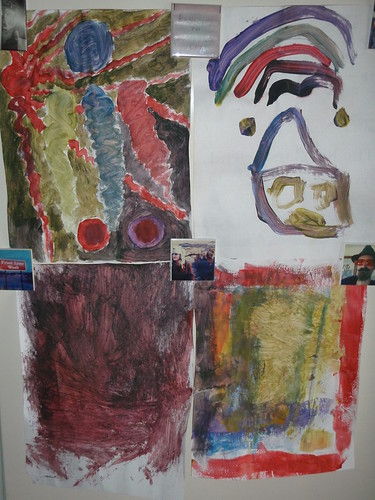
Paintings on the fridge


As we were putting the books away, she noticed the poster paint stored in the cabinet, and now she wanted to paint. Not long after we began painting, she went out into the street and returned with three other children, and we spent the rest of the day painting and playing games. The children kept me busy portioning out cups of paint and whatever one-sided used paper I could find in the house, hanging pictures on the clothesline to dry, and trying to resolve minor disputes without the words to do so while, my friend Jerry did some cleaning and slept on the couch and Heidi and Mercedes, leaders in the Bufones Fieles community in Managua, talked religion and philosophy over cups of coffee.

Though slightly overwhelmed by the chaos, I was immensely grateful for how the Casa Misionera had become almost exactly what I had hoped for in just a couple days. I am also filled with wonder at how eager people of all ages seem to be for something useful to do, even something as simple as cementing a lid, and how that can be an entry into relationship. Sometimes as I walk the streets or talk to people at work, or the store, or a party, I feel like we are all waiting for someone to open the door and let us out of a culture that tries to confine us to an identity as consumers, and into a culture of helping, and the wonderful connections that abound in that world.

How great it is to be offered help, and how great it can be to be asked!
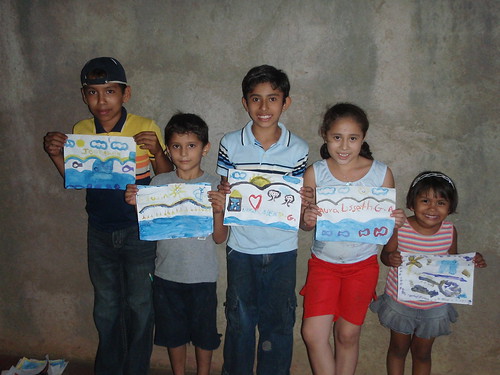
Pinturas with their favorite paintings of the day.  Click here to see more artwork.

Saturday, January 22, 2011

Throwing stones

“Buenas!” is the greeting we use in Nicaragua to announce our arrival at someone's house – no one has doorbells, and you usually arrive at a fence or gate, which isn't great for knocking.  It is also what people say as they arrive at the pulpuria next to the Casa Misionera, and I still haven't mastered hearing the difference between a “buenas!” at my door and the bank-teller like window where people buy the wares of the pulpuria.  This has me, in my desire to be a welcoming presence in the barrio, frequently answering doors that aren't really for me and getting to see who has come to the store my neighbor Gladys keeps in her house.

Mostly there are kids.  School is out, so the children accompany their parents, or get sent on errands, or are offered a couple cordoba for candy or gum.  When kids come to the pulpuria, they play in our front yard.  We put down gravel over the hard-packed dirt that surrounds a handful of jungle plants planted there, which has inspired a new game: Throw The Rocks.

One day I decided to join the juganderos, a girl of about six and a boy closer to four years old.  They were playing the current favorite version of the game: Throw the Rocks in the Hole.  I grabbed a small handful and began tossing rocks into the hole in the sidewalk.  I didn't find it very challenging, so I tried to ask the children how it was for them.  Through the screen of my very limited Spanish, I got the impression that it wasn't amazing for them either.  I then tried to explain that the logical end of this game was going to be all the rocks in the hole, and none on the garden, which I thought would be no fun at all.  I tried to teach them to juggle the rocks, but they weren't finding the challenge of throwing and catching the small stones worth the amusement it offered.  They preferred challenging me to juggle four rocks, which had a similar lack of payoff for me.  After a few minutes they took off, all of us smiling.

This leaves me wanting to find a new game to play with the stones.  I want the kids to feel like the Casa is a resource for them, as is its intended purpose.  As a resource, I also want it to be something that the children feel encouraged to take care of.  I wonder if helping the kids find a way to play in the yard can be a part of a process of seeing all of the community's (and the world's) resources as available for use and worth taking care of.  I don't pretend that finding a new game here will, by itself, keep these kids from becoming the robbers who are spoken of so often in the barrio, or from becoming the robbers-with-ties my neighbor Max talks about.  I do feel like it is worth trying to make a difference in every small way I can, and getting to look out for evidence of changes down the line.

As of right now my leading idea is to start a rock-stacking contest...


Friday, January 21, 2011

Welcome to Managua


Flying into Managua at night, the city lights twinkle like a vast net of X-mass lights – alternating yellow and white lights pop up from behind jungle trees as the plane glides by. In mid-January the government's X-mass light displays are still up in major intersections. Managua is unlike any other city I have flown into because it is so flat – almost no buildings over one story have been built since the earthquake in 1972, and there are barely any downtown high-rises.
The sprawling sea of single-family homes reminds me of L.A., but it feels different to me than L.A., where the sprawl means so many cars and freeways, and isolation.  In Managua, the homes are much smaller, and people rely almost completely on buses and taxis to get around.  People are out in the streets with each other – waiting for buses, hailing taxis, walking, shopping at open-air stalls, selling water, watches or treats off of their own backs. The small homes are right up against each other, too; not only can you hear your neighbor's house, at night you can hear your neighbor's neighbor's house as if it is your own.  Somehow, even the walls and grated windows don't seem to separate us so much. We all have them, and we are all held prisoner to the intense shortage of material wealth in the western hemisphere's second poorest country.  Rich and poor, we all have something someone else might want, and might walk off with, given the chance.

My first night alone in the Casa Misionera was not an easy sleep.  I was conscious that we had not had water in days, and needed to be alert for the sound of the pipes trickling or of my neighbors collecting water themselves – a pump running or the splash of buckets filling storage barrels.  All I heard in the end was cats crawling across the roof, the wind through the trees, and the sounds of dogs barking and people blowing whistles in the deserted streets – I've been told the whistles are robbers communicating in some secret code, which intrigues me greatly.
The water did not come – leaving me to ask myself how much I really need, and how much trust I should have that it will come before the reserves are used up.

Welcome to Managua!

Saturday, January 8, 2011

Beginning

Happy New Year!

I start this writing project as part of my reflection process this year, reflecting on journeys, walking, my recent work with the Faithful Fools and the 2010 Census, time spent in Nicaragua, in wilderness, and on the streets of cities throughout the US and the world. I write because I want my action to be strong, purposeful, effective, and adaptive, and reflection and action nurture each other as they grow together. Thank you for taking the time to enter this reflection with me, whenever it is you found the time to read this.

As I write and work this year, I want to start with following ideas as my guideposts: 1) things aren’t as bad as they seem, 2) I (and therefore everyone) can make a difference, 3) personal experience is the most direct path to truth. I pose these ideas as questions, hypotheses to test through experiment, contemplation, and discussion. I invite you to join me in these tests, and encourage you to conduct your own experiments, contemplation, and discussion, and to share your results with me!
Let me take a moment to flesh these ideas out a bit, so we can watch for them together as I continue my reflection:
1) Things aren’t as bad as they seem. I spent yesterday morning, as I do most mornings in San Francisco, listening to news on the radio. The news, as we know, is overwhelmingly negative: wars, crime, injustice, political fights, and disasters predominate. It is easy to hear all of this and feel like the world is in bad shape, and when compounded by pain and difficulty in my own life and the lives of those close to me, I can sometimes feel despair creep in. It is important to hear the news of the world’s problems, and that of my friends and loved ones, and to feel the pain of loss and outrage at injustice. At literally the same time, it is important to remember that the world and its people are beautiful, and that rays of hope are working to pierce every dark cloud – when I do, it feels like things aren’t as bad as they seem.
2) I (and therefore everyone) can make a difference. As mentioned above, all is not right with this world. It follows that some things can change for the better. A good friend has cancer – I can help, by laughing with her, more directly by helping her get to doctor’s appointment, or in some other ways she and I can dream up. There is no reason to think I can cure her disease, but I can make a difference in her life. There is a bumper sticker advising us to “Think globally, act locally.” The kind of small difference I can make in one person’s life changes the world only in that the world is made up of people (and other living and non-living things) and many people making these small changes can add up to a larger change. If I am thinking globally (or scaling up to community, city, state or nation) as I am acting locally, I may be led into associated action that can have a larger-scale effect.
3) Personal experience is the most direct path to truth. We learn in so many different ways: some things we are taught, shown or told, some we come to understand through imagining in thought experiments, and others are experienced. Over the course of my life, a tremendous amount of information has been given to me by various authorities: by my parents, teachers, and elders, in books, films, TV shows and songs, and through the news, among other sources. It has been crucial at times for me to accept the accuracy of this information, and I have been taught to believe these authorities. What if the information I gather from experience conflicts with the information given to me by authorities? I propose that my own experience is more valid for me than information given to me by authority figures, and that the closer someone is to actual experience, the more credibility I should lend them. If a farmer in Nicaragua tells me his crop yields have declined since he began using a pesticide, I should listen to him over the scientist in the U.S. who tells me the pesticide is good for growing crops in Nicaragua.

Thanks again for joining me in this journey, and in advance for helping guide and deepen it.
Until next time…